
What Does It Actually Mean to Kill Your Ego?
A deeper look at ego death, what it is, what it isn't, and why it never happens just once

I sat in front of a fire in a healing ceremony in the mountains and for close to an hour, no matter what I tried, I couldn't open up and speak coherently to the people around me.
Something was happening that I couldn’t control, and the part of me that has spent a lifetime performing, even in the spaces I most want to open, rose up and said no. Not this time. I will not perform for you. Not even here. Not even for these people who feel like family. Not even for myself.
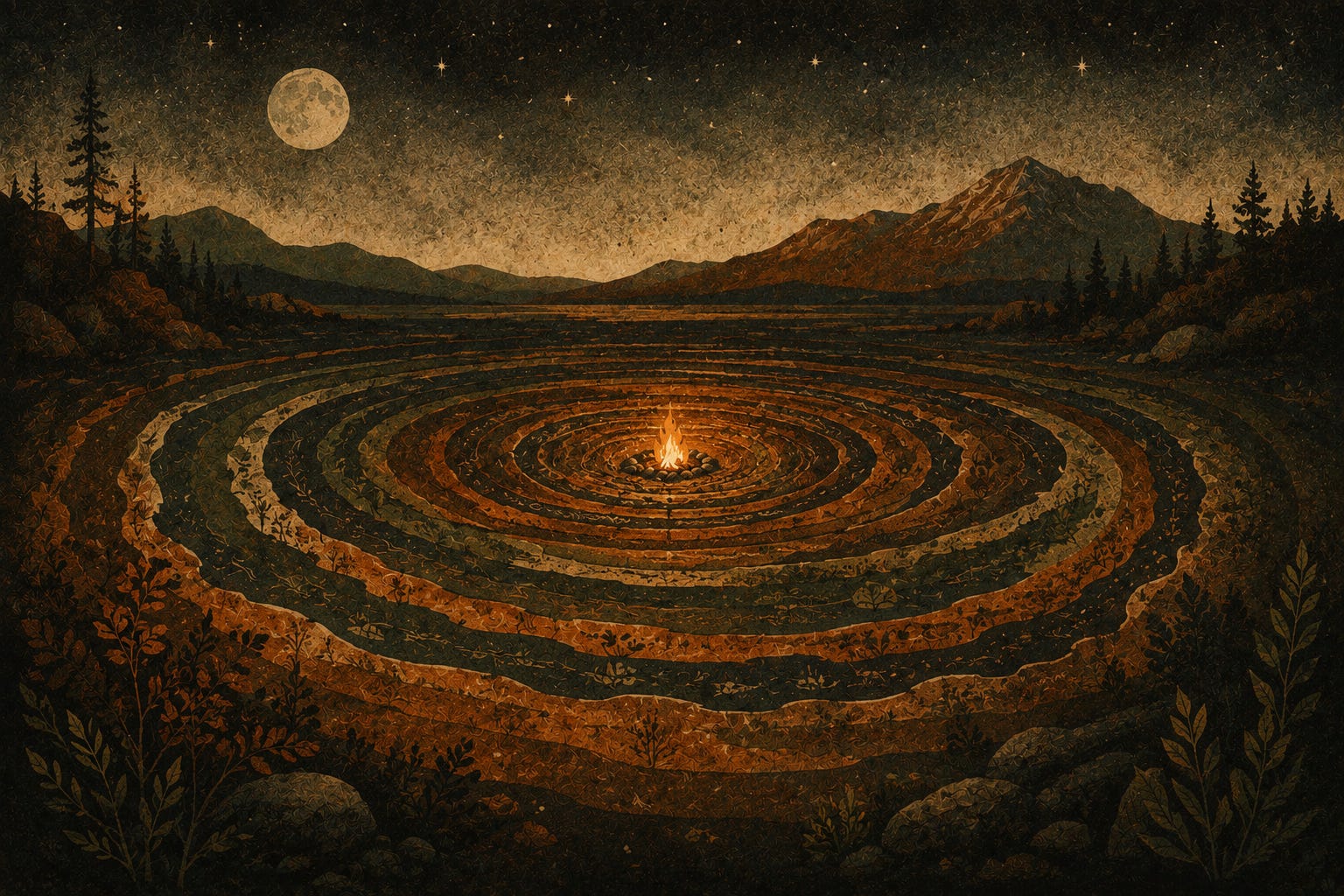
I sat there sweating and immovable at the center of the circle, the sun shining hard into my eyes, while my teacher worked gently and skillfully to find the door. There wasn’t one. The circle was quiet around me. The fire was close. And somewhere in that time, I started to see what was actually happening: a part of me I had never met quite so directly before had been quietly running the show in ways I couldn’t see until I was sitting in the full heat of the sun, refusing to cooperate.
I had done years of this work. Therapy. Plant medicine. Somatic healing. Nervous system rewiring. I had excavated the big stories, the ones my teacher calls the low-hanging fruit, and I had felt the unmistakable lightness that comes when something you’ve been carrying for decades finally puts itself down. I thought I knew who I was becoming.
What I found in front of that fire was a story I didn’t even know I was still telling.
Which is when I understood something I hadn’t before: the deeper you go, the harder the layers become to see. Ego death is not a destination. It is not something that happens to you once. It is an ongoing excavation, layer by layer, story by story, each one revealing another underneath, some of them so closely woven into the fabric of how you move through the world that you genuinely don’t know they’re there until something strips away everything else and leaves you sitting in the heat, stubborn and sweating, staring into a fire.
This is what I’ve been learning about the ego, and about what it actually means to shed it.
What I thought ego death was
In the spring of 2024, my National Geographic cover story was published. A childhood dream, finally realized. And I felt almost nothing. (I’ve written about this story before, so I won’t repeat the details here.) What came instead of the satisfaction I expected was a slow, unsettling recognition: the story I had been telling about myself, the one I had organized my entire adult life around, had finally reached its peak. And somehow, standing at the top, I couldn’t find myself anywhere in it.
That was the beginning of what I now understand as an ego death. What came after was quieter and more devastating than I expected: a slow recognition that the person I thought I just was might instead be something I had constructed with stories and credentials over the course of thirty-something years.
What followed was, in many ways, exactly what the spiritual traditions promise. I began to see the big stories clearly: the identity organized entirely around achievement, the self-worth that depended on external validation, the version of me that had learned to perform lovability rather than simply be. As I started to name those stories and stop feeding them, something genuinely shifted. The weight of them lifted. I felt lighter, more present, more honestly myself than I had in years.
The low-hanging fruit. The obvious stories, the big ones that have been shaping your life for so long that once you finally see them, you can’t unsee them. The shedding of those stories is real and it is profound and it does change you.
But it is not the end of the path. It is, I’m learning, closer to the beginning.
What is the ego, really?
Ego has come to mean a few different things depending on who you ask. The dictionary will tell you it’s self-importance, vanity, an inflated sense of one’s own worth. Freud had a more inward-facing version, the rational mediator between our instincts and the demands of reality. And somewhere along the way, Instagram turned it into a personality flaw you’re supposed to overcome, the thing you check at the door before entering a healing circle. None of those are what I mean here.
The ego, as I’ve come to understand it through years of my own unraveling and the deep study of consciousness that followed, is something far more ordinary and far more pervasive than any of those definitions suggest: it’s a collection of stories we tell ourselves about who we are.
Almost everything we think we know about ourselves, what we’re worth, where we belong, is a story. Personal stories handed down by the families we grew up in. Ancestral stories that shaped how our grandparents understood safety and survival. Societal stories about what a successful life is supposed to look like. And the private stories we’ve been quietly telling ourselves since childhood, about whether we’re enough, whether we’re lovable, whether we have to earn our place in the world.
These stories accumulate. They layer over each other, and somewhere along the way, we stop noticing that they’re stories at all. We start experiencing them as simply who we are. They are the architecture of how we experience being alive.
What makes the deeper layers so much harder to untangle is that by the time you reach them, you’ve already done enough work to feel like you know yourself. The obvious stories have been named and released. What remains is subtler, more closely woven into the fabric of how you move through the world, more surprising when it surfaces, because you genuinely didn’t know it was there.
When the story starts to collapse
I spent most of my adult life as a storyteller. Professionally, it was my entire job: to find the image that told the whole story, to read the light, to hold the frame long enough for something true to emerge.
What I couldn’t see until much later was that I was doing the same thing with my own identity, building the story just as carefully. Every credential added another layer, every assignment reinforced the narrative, and each achievement was a story that made the next one feel more necessary. The ego doesn’t just accumulate stories, it depends on them, needing constant reinforcement to maintain the feeling of solidity.
I reinforced mine by telling it over and over: when people I met at parties asked me what I do, in the way I introduced myself professionally, in the quiet inner monologue that was always running and taking stock of whether I was doing enough to justify the story I was telling. I rejected, often unconsciously, anything that didn’t fit, feelings that suggested I wasn’t happy, relationships that asked me to be more present than productive, the quiet voice that kept surfacing in unguarded moments asking whether any of this was actually mine.
In February 2020, I flew to Germany to visit my parents before what was supposed to be a major assignment, and the world shut down three weeks later.
For the first time in my adult life, I had nowhere to go and nothing to produce. The entire architecture of my identity, the movement, the assignments, the accumulation of the next impressive thing simply stopped. While my colleagues were learning guitar or writing books in their pandemic-induced isolation, I was crying in a dark room, facing down my ego.
When you remove the stories, even temporarily, what’s left feels disorienting in a way that’s hard to describe: uncomfortably, achingly empty, like a longtime home with all the furniture gone, right before you move out.
The spiritual traditions that work with ego death don’t promise you that this part will feel good. They promise that it’s necessary, that the emptiness isn’t the absence of something real but the space that opens when something constructed finally releases. And in that space is freedom.
I didn’t understand that then. I just felt lost.
The precision I brought to reading a landscape or an animal in the field, I simply could not bring to my own interior life. The ego doesn’t just tell stories, it controls what you’re willing to see. For most of my career, I wasn’t willing to see how much of my sense of self depended on external validation, how hollow the cover story felt, how little I actually knew about what I wanted when no one else was watching.
There is a concept in Buddhism that things change simply by being witnessed. You don’t have to resolve what you find, or heal it, or turn it into a lesson. The act of bringing attention to something that has been operating in the dark is itself transformative. Jung said the same thing from the other direction: until you make the unconscious conscious, it will direct your life.
Both of them were pointing at the same thing. The stories don’t need to be defeated, they need to be seen.
The armor we mistake for skin
It took me years to see this clearly: the ego is not your enemy.
The stories you built yourself around, the impressive resume, the carefully maintained identity, the narrative of who you are and what you’re worth, those weren’t vanity. They were survival.
You built them because somewhere early in your life, you learned that being a certain kind of person made you safer, more loved, more acceptable. You learned which version of yourself got the warmth and which one got the cold shoulder. And you were intelligent and adaptive enough to become very good at being the version that worked.
We talk about killing the ego as though it’s an enemy to defeat, but it’s actually your armor, extraordinarily well-crafted and deeply familiar armor that you’ve been wearing so long you forgot it wasn’t your skin. It was built by a child who didn’t know any other way to feel safe. Treating it as an enemy is often ineffective, and just keeps you at war with yourself.
What actually loosens its grip, I’ve found, is compassion, the kind you’d offer that child who built the armor in the first place.
Ego death isn’t about destroying yourself. It’s about finally feeling safe enough to take the armor off, and to ask, maybe for the first time, what’s actually underneath.
What the body remembers
There is a layer of this work that the mind cannot reach on its own.
You can identify a story intellectually. You can trace it back to its origins, name the wound it grew from, understand exactly how it shaped your choices and your relationships and the way you moved through the world. You can do years of therapy and coaching and plant medicine work and feel, genuinely, that it no longer has its hooks in you.
And then something happens, and your palms start to sweat.
The yogic traditions have a word for this. A samskara, literally a “groove” or “impression,” is the mark left in the body and subconscious mind by every significant experience we’ve ever had. Not just the traumatic ones. Every repeated thought, every habitual reaction, every story we’ve told ourselves enough times that it stopped feeling like a story and started feeling like reality. These grooves don’t disappear when we understand them intellectually. They run deeper than understanding. They are carved into the way our nervous system responds to the world, which is why you can know, with complete clarity, that an old story no longer serves you, and still feel your heart rate spike when something brushes against it.
A few weeks ago, sitting in front of the fire at a healing ceremony, my teacher looked at me and said something I wasn’t expecting: “You need to move your body. Something is still trapped in there.”
Mentally, I feel freer than I ever have in my life. The big stories have been named and released. The weight of them has lifted in ways that still surprise me sometimes. But physically? My body tells a different story. It aches in ways I am only beginning to understand, from years of playing small and holding back, of contorting myself to fit what was expected, of performing a version of myself that required a particular quality of containment to maintain. That contortion left marks.
Days after the ceremony, I was in a coaching session with a client. She was sharing something deeply personal, a story from her own life, and somewhere in the middle of it I noticed my heart pounding in my ears. My breathing had gone shallow. My palms were damp. There was a sensation in my chest that I recognized from a long time ago, the feeling of being an animal in an unlocked cage, frantic to leave but refusing to move.
The story she was telling was close to something I had been through myself. Something I had worked on thoroughly, in therapy, in ceremony, in coaching. Something I would have told you, with complete honesty, that I was over.
My body disagreed.
The moment lasted maybe ten seconds. I noticed it, came back to presence with my client, and it passed. But it stayed with me afterward, because it was confirmation of what my teacher had seen in me just days before: the stories don’t just live in the mind as narratives we tell ourselves. They wrap themselves around the nervous system. They encode themselves in the way we breathe, the way our shoulders hold tension, the way a certain quality of silence in a room can make our heart rate climb before we’ve consciously registered why.
This is why intellectual understanding, as valuable as it is, is often not enough. You can make a story conscious, name it, vow to release it, and still find it living in your tissue, waiting for the right trigger to remind you it’s there.
It doesn’t mean the work you’ve done hasn’t mattered. In that session with my client, I noticed my body’s activation and came back to presence, while a few years ago I might have gotten swept up in it. But it is a reminder that the path of shedding your ego is not a linear progression from unconscious to conscious, from wounded to healed. It moves in layers, and some of those layers are stored somewhere the thinking mind cannot simply decide to release.
The work, at a certain depth, stops being cognitive entirely. It becomes something you have to feel your way through, breath by breath, sensation by sensation, present moment by present moment.
Which is what brought me to the fire.
The fire
In that ceremony in the mountains, I was sitting across a fire from my teacher with a circle of people around me who feel like family. A container I trust completely, with people I love, in a setting I had chosen deliberately. The ceremony had a shape to it: over multiple days of that work, each person comes to the center of the circle, names what is moving through them, and speaks with our teacher while the circle holds witness. I had come in with intentions. I thought I had clarity.
As soon as I sat down at the center, a wall went up. The more I tried to open, the taller it became. I sat on the mat staring directly into the sun, uncomfortable and also completely immovable while something in me refused to perform a breakthrough.
After thirty or forty minutes of bearing down on the moment, I started to see what was actually happening. It was a young part of me, the part that spent an entire childhood being the good girl, performing for love, doing what was expected, making herself acceptable so that she could be safe.
That part had, somewhere along the way, become exhausted. And when it finally felt the eyes of the circle on me, the quiet expectation that I would open, speak beautifully from my higher self, offer something graceful and then make room for someone else, rose up and refused to comply.
I sat there for an hour in the heat and the discomfort, and I let that part of me have the floor. I did not override it, I did not do what was “right”, I did not speak from my higher self or offer gratitude or tie things into a neat bow. I sat there, stubborn and sweating, taking up space in the most unhelpful way imaginable, and I let myself be exactly what I was in that moment: a person who did not want to cooperate.
And underneath that defiance, as I sat long enough to see beneath the discomfort, I found two stories running simultaneously. The first was: I am the good girl. I must perform to be loved. The second, which had grown up in the shadow of the first without my realizing it, was: we’ve done everything we were supposed to. We’ve been good for long enough. Now we get to do whatever we want, and right now we don’t want to be good.
The first story, I thought I had already shed. The second I didn’t even know existed until I found myself sitting in front of that fire.
This is what I mean when I say ego death is not a destination. You shed one story and discover another living in its shadow, and then another beneath that. Your higher “self” is not a single locked room you eventually open. It’s a series of rooms, each one revealing the next, each one requiring the same quality of attention and the same willingness to see without flinching.
The defiant part of me isn’t wrong, by the way, and neither is the part that showed up to that ceremony wanting something real. Both of them are true, both of them are there, and the work isn’t to silence one in favor of the other. It’s to let both be witnessed, to stop pretending that the human self who wants to sit in the sun and refuse to cooperate is less real or less worthy than the higher self who wants to grow.
What I wrote down afterward, in the quiet after the ceremony, was this: I have come to understand that I should give when I can and rest when I need. But what I haven’t yet fully embodied is that I never have to force myself to give.
There is still a part of me that tells me: Give. Smile. Be friendly. Be nice. Even when I don’t want to. And somewhere along the way, that part of me became the authority, the very thing I wanted to rebel against. What I actually want, what I eventually asked for from the fire, what that defiant young part of me was reaching for, is:
the freedom to act from my heart regardless of what other people think, or even what my mind thinks is best.
That is not a small thing to want, or a simple thing to find, and I’m very much still on that journey.
What ego death actually means
None of this is an argument against having an ego. We need stories to function in this world. If we want to stay engaged with society as it is right now, we need identity, a name, a history, a sense of self that can navigate a conversation and hold down a job. The ego isn’t the enemy. The suffering comes not from having stories but from holding them so tightly that we forget they’re stories at all, from letting them become the cage rather than the container.
The invitation is to hold the stories lightly enough that you can set them down when they stop serving you, and remember, underneath all of them, who you actually are.
Jung was right that what remains unconscious will run your life. But what I’ve found is that the moment you turn toward it, the moment you let it be seen rather than managed or overridden or spiritually bypassed, something in it begins to soften. Slowly, the grip loosens, and the story loses a little of its authority over you.
Each time we let a part of ourselves be witnessed rather than managed, it smoothes the edges of a samskara that has been routing us the same way for years. The groove doesn’t disappear overnight. But it gets shallower, and eventually, the signal starts to find a new path. In that loosening, something else becomes more available. Something quieter and more enduring.
There are many names for it: Pure being. Consciousness. Presence. Loving awareness. The witness. The observer. The Soul. Sat-chit-ananda. The traditions use different words that point at the same thing.
What I know is that it feels like freedom. It feels like coming home to a place you’ve always been, a place that was always there, waiting patiently beneath every story you ever told about yourself.
And so we keep going back, layer by layer, story by story, fire by fire. Not because we’ll eventually finish, but because each time we return, we remember a little more of what was always true.
✨
I write about the threshold between who we’ve been performing and who we actually are. If this found you at the right moment, you’re not alone. Welcome.
✨ If this resonated, there’s more.
You’re here because something inside you is stirring — a quiet knowing that the life you’ve built, while impressive on paper, doesn’t quite match the truth of who you’re becoming.
The words above are just the beginning. The real work happens in the liminal space between knowing and living, between the old map that no longer fits and the unmarked trail ahead.
This is where I walk with people: through the threshold from performing their life to actually living it. From the frantic energy of “an animal in a cage” to the grounded presence of your wild beyond: to remembering who you were before the world tamed you.
If you’re ready to stop analyzing what’s wrong and start embodying what you already know is true, let’s connect:
→ Work with me at Wild Beyond Coaching
→ Follow the journey on Instagram @wildbeyondcoaching
Very thoughtful and beautifully written. I easily recognized many of the feelings, emotions, and mental processes associated with the continual passing of my stories and ego. It is definitely an ongoing process, but well worth it.