
The Root Response
What plants know about starting over (and why it matters for our own growth)

I noticed it in one of my houseplants, a spotted laurel, this week.
Stems that had been reaching confidently toward the window stopped growing a few months ago. I was puzzled — they weren’t dead, and looked otherwise healthy, but they just completely stopped putting out new leaves.
And then, almost imperceptibly, something new began moving at the base this week.
A small shoot, tight and green and determined, pushing up from tissue that had been dormant for as long as I’d owned the plant. Over the last few days, it’s been growing quickly, a new stem covered in tiny leaves.
I almost missed it. I was looking at the top, the way you do, assuming that’s where the story was happening.
It wasn’t.
Here's what's actually happening, and why I haven't been able to stop thinking about it in the context of our human journey.
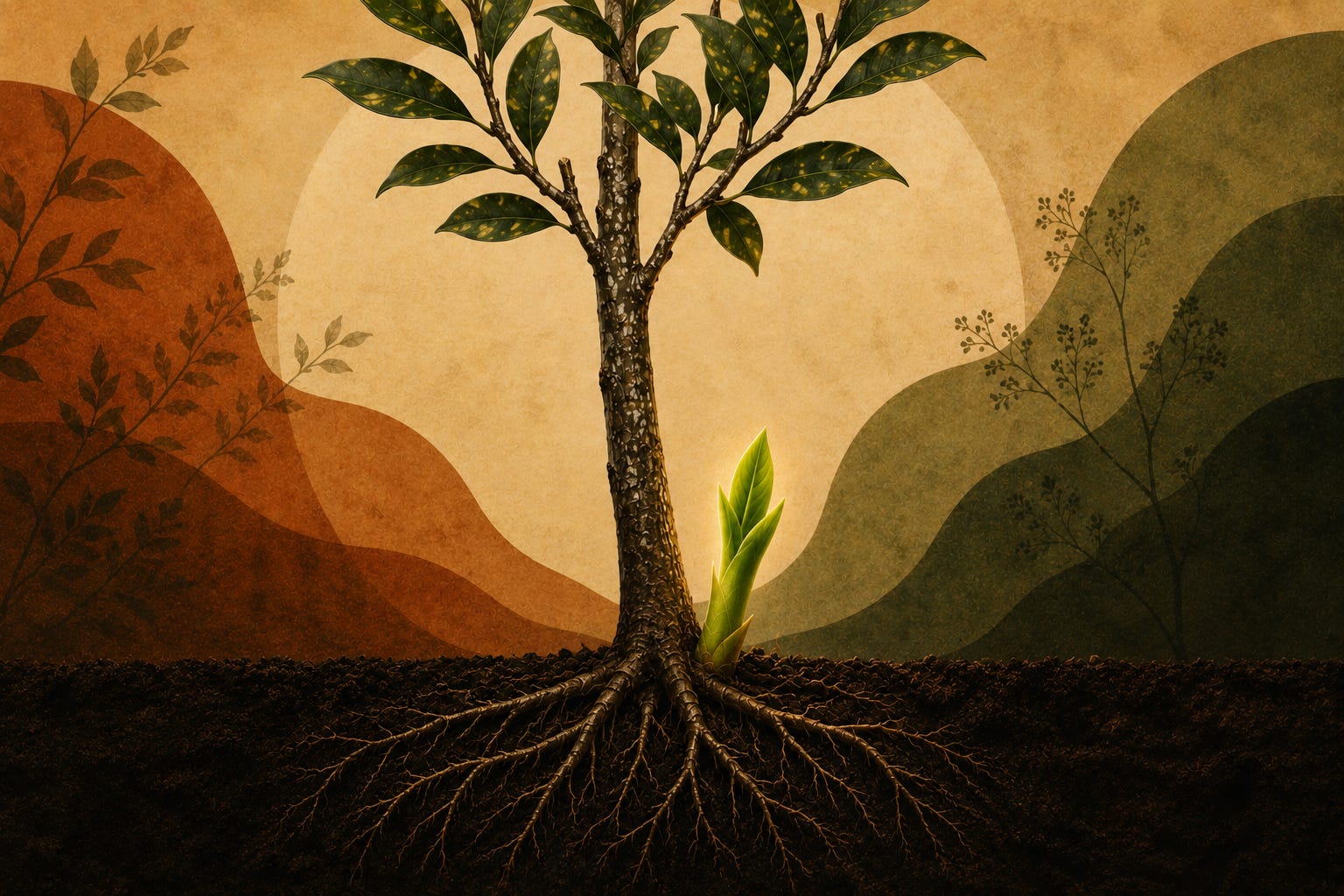
Many plants have dormant buds near their base, buds that sit quietly, held in check by hormones produced by the dominant growing tip. The tip says, essentially: I’ve got this. And everything else waits.
But when that tip gets damaged, pruned, shaded, frost-burned, overwhelmed, the hormonal signal drops. And the plant, without drama or deliberation, initiates the root response. Those dormant buds wake up. New shoots emerge from the base, often growing faster and more efficiently than the old stem ever did, because they’re not burdened by years of accumulated growth. They’re fresh tissue, better positioned, more adaptable.
This isn’t failure. This is wild intelligence operating exactly as it was designed to.
What strikes me is how different this is from the story we tell about growth.
We tend to imagine growth as a single upward line, one stem, one trajectory, reaching higher and higher until it becomes the thing it was always meant to be. We reward this in people too. Consistency. Momentum. The unbroken ascent.
But many plants aren’t trying to become one permanent towering structure. They’re continuously replacing themselves, piece by piece, staying adaptable instead of fixed. Grasses do this. Aspens do this. Blueberries, willows, prairie perennials, keystone species in whole ecosystems built not on permanence but on the capacity for renewal.
The near-ground buds, it turns out, are often the safest. Protected from wind, from fire, from the temperature extremes that batter exposed growth. What looks like pulling back is actually the plant returning to its most resilient tissue, the part closest to the root, where the real resources live, where conditions are steadier and the ground holds.
We tend to read inward movement as contraction. As giving up, or giving in. But in the biology of living systems, moving closer to your own center isn’t retreat. It’s where the most durable growth begins.
I think of it as coming home to yourself. Checking in on what’s actually true, beneath the momentum and the performance and the story you’ve been sustaining from the outside. The question the plant is always asking (is this stem still worth investing in?) is the same question we’re often most afraid to sit with honestly. Because if the answer is no, everything has to shift.
But here’s what I’ve learned, both from years in wild places and from the work I do now: the people who are willing to ask that question, and stay with it long enough to hear an honest answer, don’t lose themselves. They find a version of themselves that’s closer to the ground, closer to what actually matters, and far more capable of growth than the old stem ever was.
I’ve done this myself, more times than I expected to. Each time, the root response turned out to be stronger than what came before, even though starting over was terrifying every single time. And the old growth didn’t disappear. Those other developed parts are still there, still part of the whole, even if their energy has slowed. A plant doesn’t abandon what it’s built. It just shifts investment toward what can thrive better in the current conditions.
Some of my clients are in this exact place right now. The old stem isn’t dead, but something in them knows it’s no longer the best direction. They’re hovering in that uncomfortable in-between, the place where the old story has stopped producing and the new one hasn’t quite shown itself yet. It looks like confusion from the outside. From the inside, it feels like the first honest breath in years.
What strikes me most about the plant is what it doesn’t do.
It doesn’t mourn the old stem. It doesn’t spend months analyzing whether it made the right call, or catastrophize about whether the new shoots will amount to anything. It just grows toward the light it can actually reach, from the ground it’s actually standing on.
This is the wild intelligence at work: living systems are not designed for linearity. They’re designed for resilience, for the capacity to hold dormant possibility even when the dominant story says there’s only one way forward.
What we call starting over, the plant calls a root response. A return to the tissue that’s closest to what sustains it. The growth that happens when the signal finally drops and something truer gets to emerge.
If you are somewhere in the middle of your own pruning, if the old tip has stopped and nothing new has quite emerged yet and everything feels suspended in an uncomfortable in-between, the dormancy is not emptiness.
It’s your wild intelligence gathering itself.
The basal buds are already there. They have always been there, waiting for exactly this moment. You don't have to force the growth. You just have to trust the signal.
✨ If this resonated, there’s more.
You’re here because something inside you is stirring — a quiet knowing that the life you’ve built, while impressive on paper, doesn’t quite match the truth of who you’re becoming.
The words above are just the beginning. The real work happens in the liminal space between knowing and living, between the old map that no longer fits and the unmarked trail ahead.
This is where I walk with people: through the threshold from performing their life to actually living it. From the frantic energy of “an animal in a cage” to the grounded presence of your wild beyond: to remembering who you were before the world tamed you.
If you’re ready to stop analyzing what’s wrong and start embodying what you already know is true, let’s connect:
→ Work with me at Wild Beyond Coaching
→ Follow the journey on Instagram @wildbeyondcoaching
I absolutely love this!
Girl you know I love a nature metaphor. This is a really wonderful one. Nature is always showing us how to innovate. How to compost what's in the way and root in deeper. INTO IT!